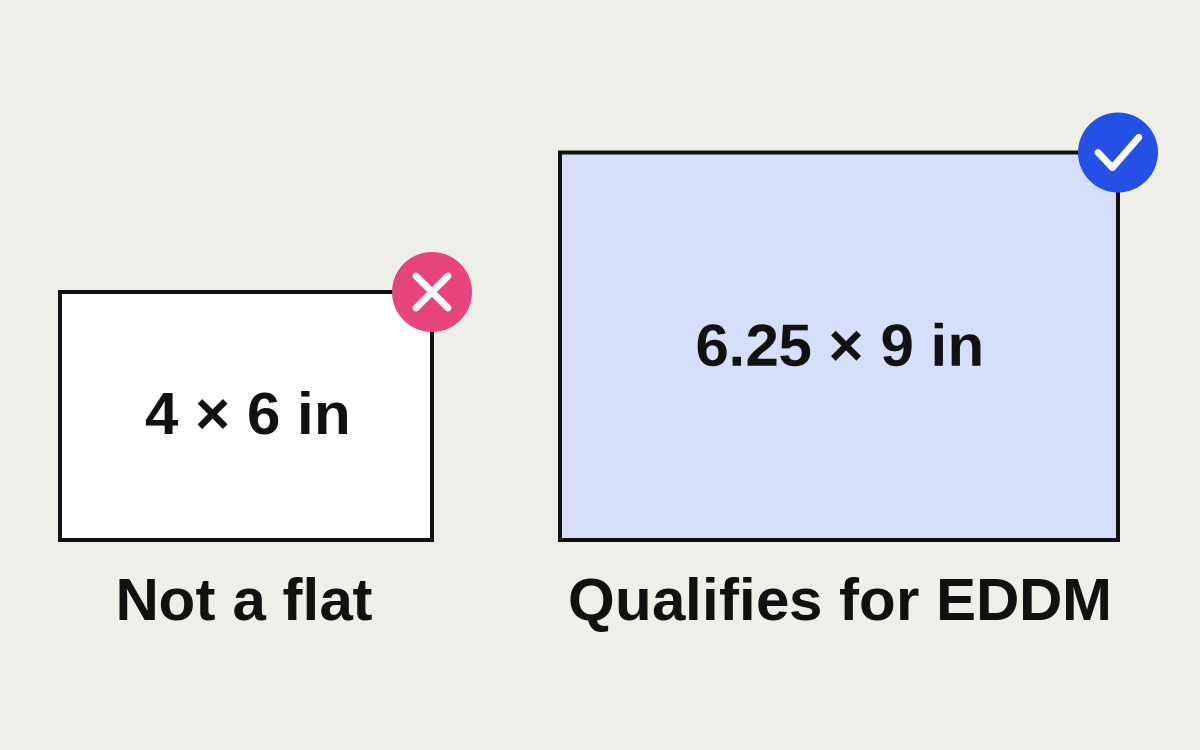
To mail through USPS Every Door Direct Mail (EDDM), a piece has to qualify as a flat: it must be longer than 10.5 in, or taller than 6.125 in, or thicker than 0.25 in, and no bigger than 15 × 12 in or thicker than 0.75 in. That's why common EDDM sizes are 6.25 × 9, 6.25 × 11, 8.5 × 11 and 9 × 12 in, and why a standard 4 × 6 postcard doesn't qualify. The address side needs an EDDM indicia in the top right and a "Postal Customer" delivery line instead of a name and address. USPS updates its rules and prices, so confirm the current requirements on its EDDM pages before printing.
What EDDM is, briefly
EDDM lets you mail to every address on chosen postal routes without buying a mailing list or printing addresses. You pick routes on the USPS map tool, print pieces with the right markings, bundle them, and drop them at the post office (EDDM Retail) or, for larger mailings, enter them through a business mail entry unit with a permit (EDDM BMEU). Because it's saturation mail, the pieces must be flats, which is where the size rules come from.
Size rules
A piece qualifies if at least one of these is true:
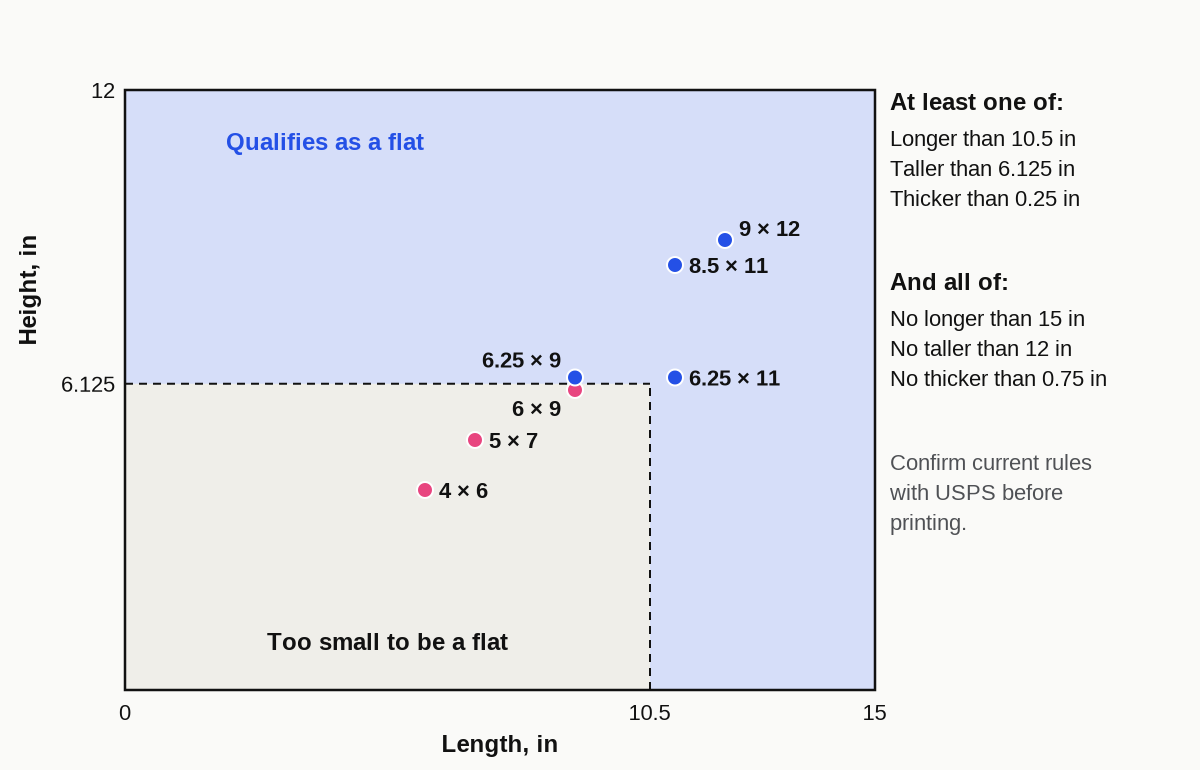
- Length greater than 10.5 in
- Height greater than 6.125 in
- Thickness greater than 0.25 in
And all of these must hold:
- Length no more than 15 in
- Height no more than 12 in
- Thickness no more than 0.75 in
For EDDM Retail there's also a weight limit, 3.3 oz per piece at the time of writing.
Common sizes that qualify
| Trim size | Qualifies because | Notes |
|---|---|---|
| 6.25 × 9 in | Height over 6.125 in | Popular, and the smallest common qualifying size |
| 6.25 × 11 in | Both | Very common "jumbo postcard" |
| 6 × 11 in | Length over 10.5 in | Same idea, slightly shorter |
| 4.25 × 11 in | Length over 10.5 in | A long, narrow format like a rack card |
| 8.5 × 11 in | Both | Letter-size, room for a lot |
| 9 × 12 in | Both | Large and noticeable |
| 11 × 17 in folded to 8.5 × 11 in | Folded size counts | Folded pieces have extra rules, such as closures; check before designing |
Sizes that don't
A 4 × 6, 5 × 7 or 6 × 9 in card doesn't qualify for EDDM: none of its dimensions passes the flat threshold. (6 in tall is under 6.125 in, and 9 in long is under 10.5 in.) Those sizes mail as regular postcards or letters with addresses.
A 6 × 9 in card, just 0.125 in under the height threshold, is a common mistake. If you've designed at 6 × 9, the fix is usually to extend it to 6.25 × 9 in, which takes a small layout adjustment rather than a redesign. Our page on the file being the wrong size covers resizing without stretching.
The mailing side
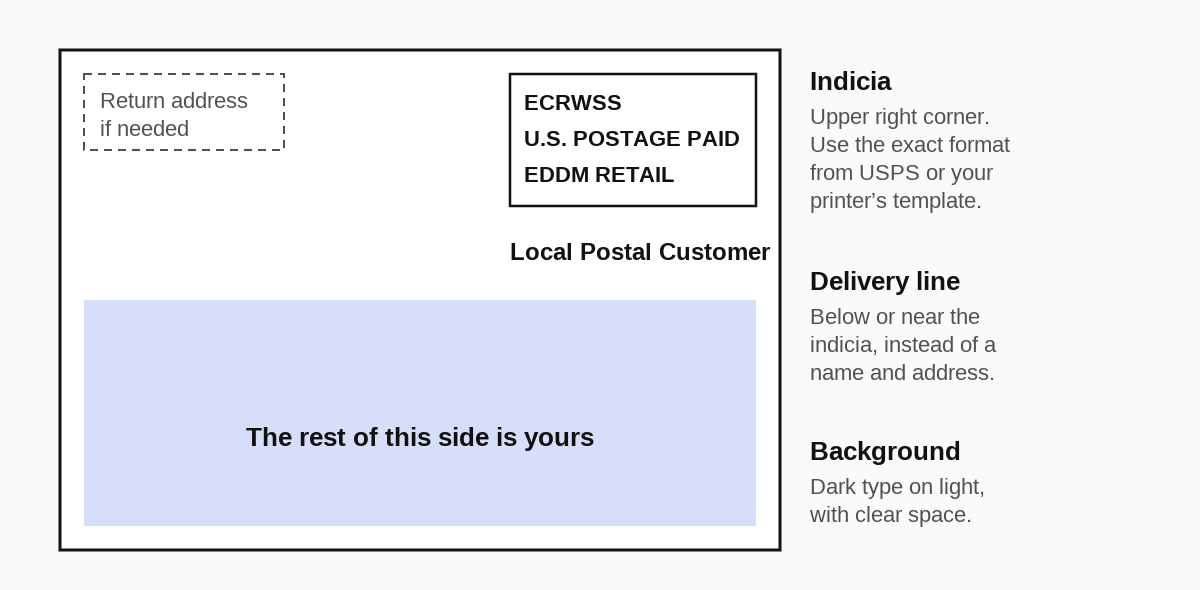
One side of the piece carries the postal markings. USPS has rules about what goes where, and printers that specialize in EDDM provide templates. The essentials:
The indicia
The postage indicia goes in the upper right corner of the address side. For EDDM Retail it includes wording such as "ECRWSS", "U.S. POSTAGE PAID" and "EDDM RETAIL". EDDM BMEU mailings use a permit indicia with the mailer's permit details instead. Use the exact format from USPS or your printer's template; don't redraw it from memory.
The delivery line
Instead of a name and address, EDDM pieces carry a simple delivery line, typically "Local Postal Customer" or "Postal Customer". It goes below or near the indicia, in the address area.
Keep it clean
- Print the indicia and delivery line in black or a dark color on a light, plain background. Don't put them over photos or patterns.
- Leave clear space around them. A cramped indicia under a coupon border is hard to read and may be rejected.
- A return address in the upper left is common and useful, but check whether your mailing needs one.
Everything else on that side, and all of the other side, is yours.
Designing for the mailbox
An EDDM card is seen for a few seconds between the mailbox and the recycling bin. What tends to work:
- One clear offer on the non-mailing side, in large type. "20% off your first cleaning" beats a list of services.
- The business name and what it does visible on both sides, because you can't control which side lands face-up.
- A strong image, preferably of the product, the result or the team, rather than generic stock.
- One call to action: a phone number, a URL or a QR code. If you use a QR code, size it properly; our page on QR codes that won't scan gives the minimums.
- A deadline or local reference, so it reads as relevant to that neighborhood now.
Mail is handled roughly. Keep text and logos at least 0.125 in inside the trim (more is safer) and avoid fine borders near the edge, which show any trimming variation.
File setup
- Trim size: the EDDM size you've chosen, for example 6.25 × 9 in
- Bleed: usually 0.125 in on each side, so 6.5 × 9.25 in for that card
- Safe area: 0.125 in or more inside the trim
- Color: CMYK, images at 300 ppi
- Pages: two, with the mailing side clearly identified (your printer may want it as page 2)
- Stock: card stock around 14 pt or 100 lb cover is common, and the piece needs to be stiff enough to handle as a flat
Bundling and dropping off (Retail)
EDDM Retail pieces are bundled, typically in stacks of 50 to 100, all facing the same way, with a facing slip on each bundle showing the route. There's a daily limit per post office for retail drop-offs. Your printer or the post office will explain the current process, and many printers will bundle for you.
A note on accuracy
USPS rules, limits and prices change. The numbers here reflect the published EDDM requirements as we understand them at the time of writing, but always check the current USPS EDDM guidance, or your printer's EDDM template, before you print a run.
A new EDDM postcard, designed to qualify and built for your printer's template, is a fixed $127 through our flyer and postcard design service.
FAQ
What size does an EDDM postcard have to be?
It must qualify as a flat: longer than 10.5 in, taller than 6.125 in or thicker than 0.25 in, and no larger than 15 × 12 × 0.75 in. Popular sizes include 6.25 × 9, 6.25 × 11, 8.5 × 11 and 9 × 12 in. Standard 4 × 6 and 6 × 9 in postcards don't qualify.
Where does the EDDM indicia go?
In the upper right corner of the address side, with the delivery line ("Postal Customer" or "Local Postal Customer") nearby in the address area. Use the exact indicia format from USPS or your printer's EDDM template, printed dark on a plain, light background.
Do EDDM postcards need an address?
No. EDDM pieces go to every address on the chosen routes, so instead of a name and address they carry a generic delivery line such as "Postal Customer". That's what makes EDDM cheaper and simpler than mailing to a list.